
imagen family: Complete Guide to Imagen 4 Fast, Standard, and Ultra in Gemini API
imagen family is Google's Imagen 4 lineup in the Gemini API, covering Fast, Standard, and Ultra model choice, pricing, limits, Gemini app differences, and rollout realities.

Image source: Wikimedia Commons (CC BY-SA 4.0), "Illuminated Valley in the Afternoon (Imagen 4.0)" by ShamaBabar.
AI Summary (2 sentences)
imagen family in the Gemini API currently means three Imagen 4 variants (Fast, Standard, and Ultra), each with explicit model IDs and paid per-image pricing. The main operational mistake teams make is treating Gemini app behavior at gemini.google.com as equivalent to API behavior, even though availability, controls, and rollout rules differ between the two product layers.
Last Verified (March 3, 2026)
- Model IDs and launch status were checked against the Gemini API changelog and model docs.
- Pricing values ($0.02 Fast, $0.04 Standard, $0.06 Ultra) were checked against the Gemini API pricing page.
- Gemini app vs API behavior notes were checked against Gemini app help and Google product update pages.
imagen family is now a practical implementation decision, not just a model-name keyword. In Google's official announcement dated August 15, 2025, the company states that imagen-4.0-generate-001 and imagen-4.0-fast-generate-001 are generally available in the Gemini API, while imagen-4.0-ultra-generate-001 remains in preview (Google Developers Blog, Gemini API changelog).
This guide uses your provided sources first, then adds current primary documentation from Google and practitioner signals from Reddit threads to separate stable facts from rollout noise. Where community posts conflict with assumptions, official docs and pricing pages take priority.
Quick Takeaways
- The imagen family in Gemini API is three separate Imagen 4 model variants, not one universal mode.
- Current paid image pricing is model-tiered: Fast ($0.02), Standard ($0.04), and Ultra ($0.06) per image.
- Gemini API model behavior and gemini.google.com app behavior should be validated independently before launch.
Jump To Section
What the provided sources establish
The launch article confirms the core positioning of the imagen family: high-fidelity text rendering, support for both photorealism and stylized outputs, and 2K generation for standard and ultra variants. Google also describes up to 75% lower latency for the standard Imagen 4 model relative to Imagen 3 (announcement source).
The Gemini API documentation then turns those claims into concrete implementation details: model IDs, generation parameters, prompt length limits, and region-dependent controls such as person generation behavior (Imagen API docs).
- Model IDs in docs:
imagen-4.0-fast-generate-001,imagen-4.0-generate-001, andimagen-4.0-ultra-generate-001. - Paid pricing per output image: $0.02 (Fast), $0.04 (Standard), and $0.06 (Ultra), with free tier listed as unavailable for these models (Gemini API pricing).
- Prompting constraints include English-only prompts, up to 480 input tokens, and 1-4 output images per request (Imagen docs).
- Google states generated images include an imperceptible SynthID watermark (Imagen docs, DeepMind SynthID).
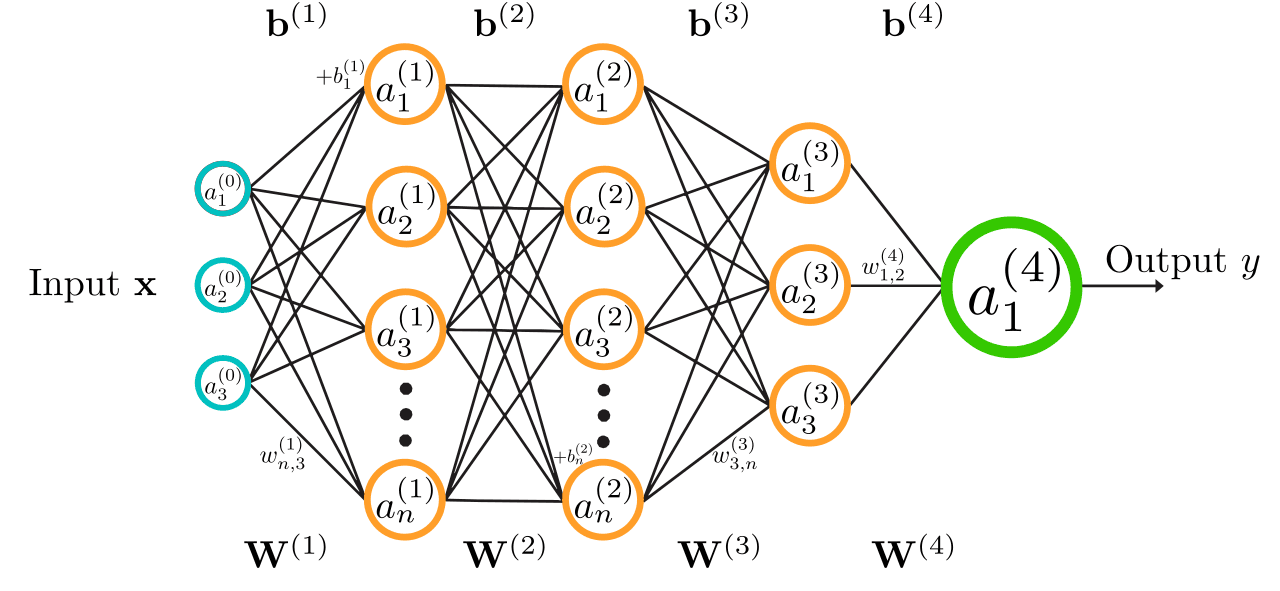
Image source: Wikimedia Commons (CC0), Neural_Network.svg.
imagen family model matrix (API view)
| Model ID | Best For | Current Price | Notes |
|---|---|---|---|
imagen-4.0-fast-generate-001 | High-volume iteration and lower-cost experiments | $0.02 per image | Free tier unavailable for Imagen 4 models |
imagen-4.0-generate-001 | Balanced quality, text rendering, production creative | $0.04 per image | Supports 1K and 2K image size options |
imagen-4.0-ultra-generate-001 | Maximum prompt adherence quality | $0.06 per image | Listed as preview in changelog context |
Pricing above is pulled from the current Gemini Developer API pricing page, and model-stage context comes from the changelog and model docs (pricing, changelog, models list).
Gemini API vs gemini.google.com: same brand, different layer
A common failure mode in imagen family rollouts is mixing API docs with consumer app behavior. The public homepage at gemini.google.com is a sign-in surface, while API model controls live in AI Studio and Gemini API docs. Google Help also describes the Gemini web app as a product available through gemini.google.com (Gemini privacy hub).
In current Gemini Apps Help documentation, image generation/editing is described as Nano Banana model workflows with account, age, language, and region constraints. That does not invalidate imagen family guidance, but it does mean app behavior should not be used as a one-to-one proxy for API behavior (Gemini Apps Help, Google product update).
- Use Gemini API docs for model IDs, parameters, and billing assumptions.
- Use Gemini app docs for end-user eligibility, language support, and policy constraints.
- Build launch checklists that separately test app UX and API outputs.

Image source: Wikimedia Commons (public domain), High performance computing data center.
What Reddit threads add (directional, not canonical)
Reddit threads are useful as rollout telemetry, not as documentation. In practice, they often expose friction points before docs are fully updated. For imagen family planning, these recurring themes matter:
- Developers reporting free image-generation paths changing in API workflows (r/GeminiAI thread).
- Paid app subscribers reporting temporary inability to create images despite plan upgrades (r/GeminiAI thread).
- User confusion around image-generation refusals that map to policy and eligibility checks (r/GeminiAI thread).
- Ongoing issues reported around image editing behavior in app rollouts (r/GeminiAI thread).
The correct inference is not that documentation is wrong. The correct inference is that account-level and rollout-level conditions create operational variance, so teams need explicit pre-launch validation scripts.
How to choose the right imagen family model
1. Start with Fast for iterative pipelines
If your workflow is concept generation, A/B concept testing, or internal creative ideation, start with imagen-4.0-fast-generate-001. The lower per-image cost supports large prompt sweeps before you lock a final direction (pricing source).
2. Move to Standard for production assets
Google positions standard Imagen 4 around text rendering quality and broad style support. For most teams publishing marketing assets or product visuals, standard is the practical quality/cost midpoint (launch announcement).
3. Reserve Ultra for strict prompt adherence workflows
When prompt adherence is the top requirement and image count is lower, ultra can be justified despite higher unit cost. Keep a simple rule: use ultra only where measurable quality deltas offset cost deltas.
Prompting and production checklist for imagen family
Based on the current Imagen docs, teams should operationalize the following before scaling traffic:
- Keep prompts in English and within the 480-token limit.
- Set
numberOfImagesintentionally (1-4) to control cost and selection behavior. - Use
imageSizeonly where supported (standard/ultra with 1K and 2K options). - Test
personGenerationsettings by region before launch, becauseallow_allhas listed restrictions in some regions. - Keep structured logging for prompts, chosen model, response status, and output acceptance rate.
- Add post-generation verification checks where user trust matters, including SynthID-aware workflows.
Practical docs: Imagen API documentation and Google's image verification update.
Fast vs Ultra and pricing FAQ (close-intent queries)
These are the most common close-intent questions around imagen family selection and budgeting, based on recurring search and Reddit phrasing. Values below use the Google pricing page checked on March 3, 2026.
| Query Intent | Short Answer | Source Anchor |
|---|---|---|
| imagen 4 fast vs ultra | Fast for iteration volume; Ultra for selective highest-fidelity runs where prompt adherence has measurable value. | Gemini pricing + launch post |
| imagen family pricing | As of March 3, 2026: Fast $0.02, Standard $0.04, Ultra $0.06 per output image. | Gemini API pricing page |
| Gemini app vs imagen API | Treat as different product layers; do not assume identical controls or rollout behavior. | Gemini app help + Gemini API docs |
| 1,000 image cost planning | Rough base model cost: $20 Fast, $40 Standard, $60 Ultra. | Calculated from listed per-image rates |
Content strategy note for ranking on imagen family
The search intent around imagen family mixes developer intent (model IDs, pricing, API differences) with product-intent confusion (Gemini app vs API availability). To rank sustainably, content needs exact keyword alignment plus fresh source-cited maintenance. For editorial rigor, follow the same citation discipline used in our internal guides on adding citations, writing for AI answers, and image SEO fundamentals.
Bottom line
imagen family is best understood as a three-model API lineup with explicit cost and quality tradeoffs, not as a single generic feature. Teams that separate API documentation from consumer-app assumptions, validate rollout constraints early, and maintain source-cited update hygiene will outperform teams that treat all Gemini-branded image behavior as interchangeable.
Related Articles
Image SEO: Alt Text, Context, and Metadata
Accessibility and metadata patterns for image-heavy pages.
Technical SEO Checklist for AI-Ready Sites
Crawl, index, and template safeguards that protect visibility.
Writing for AI Answers: Structure and Evidence
Editorial format and citation rules for answer-style content.
SEO Dashboards and KPIs in 2026
Measurement framework for AI-era traffic and conversion analysis.
FAQ: imagen family
Sources
- Google Developers Blog: Announcing Imagen 4 Fast and Imagen 4 family generally available in the Gemini API
- Gemini API Docs: Image generation (Imagen)
- Gemini API Pricing: Imagen models
- Gemini API Changelog (August 15, 2025)
- Gemini API Models list: Imagen section
- Gemini homepage
- Google Privacy Hub: Gemini app/web app overview
- Gemini Apps Help: Generate and edit images with Gemini Apps
- Google Blog: Gemini update with image editing and generation
- Google Blog: Add images in Gem with our latest image generation model
- Google Blog: Gemini app gets image verification for SynthID
- DeepMind: Responsible approach to building watermarks into GenAI technology
- Reddit: Gemini API just removed the Gemini 2.0 Flash Image Generation free option
- Reddit: Pro Gemini account won't let me create images anymore
- Reddit: Won't make images
- Reddit: Issues with Gemini image editing
- Wikimedia Commons: Illuminated Valley in the Afternoon (Imagen 4.0)
- Wikimedia Commons: Neural_Network.svg
- Wikimedia Commons: High performance computing data center image
Updated March 3, 2026. Verify pricing and model stages before production decisions.